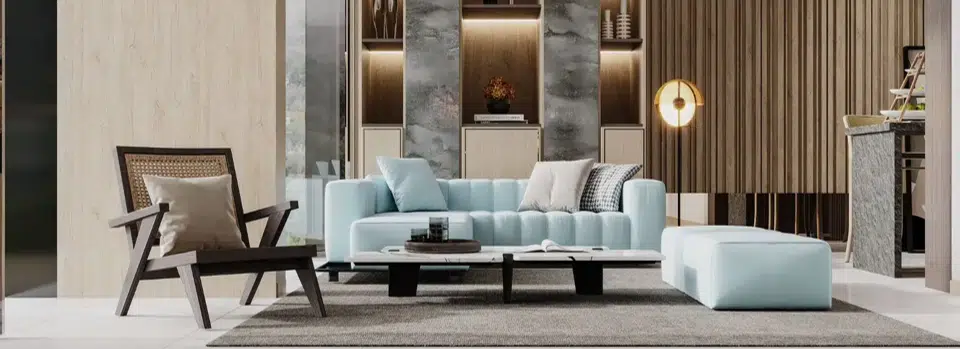
The Importance of FF&E (Furniture, Fittings and Equipment) in Interior Design

What’s FF&E (Furniture, Fixtures and Equipment)?
FF&E stands for furniture, fixtures, and equipment.
It covers movable items that are not permanently attached to the building structure. In other words, FF&E is separate from the main construction of the building and is typically brought in after the structural and interior works have been completed.
Furniture fixtures and equipment can include desks, chairs, tables, sofas, bedframes, bedside tables, lighting, storage units, decorative elements, and other movable items used within a space.
Equipment can also include tools, appliances, machinery, or specialised equipment necessary for operations. These items are generally intended for multi-year use rather than being treated as everyday consumable items.
FF&E is a crucial element in interior design because it plays a major role in how a completed space looks, feels, and functions.
When styling an office space, for example, an FF&E service can include sourcing desks, chairs, workstation designs, lighting, storage, and equipment to match the overall interior design.
In residential settings, FF&E can include furnishings such as lighting, a bedframe, bedside table, sofa, dining table, chairs, decorative objects, and other items that complete the interior.
In commercial real estate and hospitality projects, FF&E may include a much broader range of furniture fittings and equipment depending on the project type, business requirements, and operational functionality.
What Is Included in FF&E?
The exact FF&E scope will differ from one project to another.
In an office, common FF&E can include:
- Desks
- Chairs
- Meeting tables
- Storage units
- Lighting
- Movable furniture
- Cable management accessories
- Workstation equipment
- Decorative elements
- Selected specialised equipment

In residential interior design, FF&E may include sofas, dining tables, chairs, bedframes, bedside tables, lamps, decorative objects, movable storage, and other furnishings.
Hospitality FF&E can be more complex because hospitality projects often involve a large number of individual items across guest rooms, common areas, restaurants, kitchens, and operational spaces.
This can include chairs, tables, lighting, built in cabinetry, movable furniture, kitchen appliances, kitchen equipment, storage, decorative elements, and specialised tools or equipment.
The most important thing is that all FF&E should support the overall design intent, functionality, and style of the space.
Why FF&E Is Important in Interior Design
FF&E does more than simply fill a completed interior.
The building structure may define the space itself, but furniture, fixtures, equipment, lighting, materials, and decorative elements help determine how people experience that space.
A well-designed space balances aesthetic appeal with functionality, so everything feels cohesive instead of overwhelming on its own.
The right FF&E can improve space functionality, customer experience, comfort, operational efficiency, and the overall quality of the completed interior.
The wrong FF&E can have the opposite effect.
You can ruin an interior design and even make a space look smaller with the wrong colour, size, style, or proportion.
Imagine purchasing an oversized bedframe that takes up all of the little walkways between walls, or choosing large desks and storage units that make it difficult for employees to move comfortably around an office.
This is why FF&E should always be considered as part of the wider interior design process.
3 Factors to Keep in Mind When Choosing FF&E
One important thing to keep in mind when choosing FF&E is how it will impact both your space and your bottom line.
FF&E often represents around 10–20% of total project costs, so the budget should not only include the initial furniture and equipment cost but also logistics, installation, storage, and maintenance.
There are three important factors to consider.
1. Find the Right FF&E
Finding the right FF&E is about more than choosing furniture that looks good.
The colour, size, material, style, and functionality of each item should work with the wider interior.
Furniture that is too large can make a space feel smaller.
Furniture that is too small may not support the way the space needs to function.
In an office, the right desks and chairs should support employees while also working with the available floor space.
In hospitality projects, furniture fittings and equipment need to support both the customer experience and the operational needs of the business.
Interior designers also need to consider how FF&E works alongside architectural features, lighting, storage, materials, and other design elements to support interior design that aligns with brand identity.
The goal is to create a space where the furniture and equipment feel like a natural extension of the interior design rather than something added at the end.
2. Compare Price
You can expect to pay a premium for the latest products, designer furniture, specialised equipment, and higher-quality materials.
With so many companies competing in the furniture and equipment industry, prices can vary significantly between brands, suppliers, materials, and product specifications.
However, choosing FF&E based solely on the lowest cost can create problems later.
A cheaper item may require more maintenance.
It may also need to be replaced earlier.
A higher-quality product may cost more initially but provide better durability, functionality, and long-term value.
The FF&E budget should therefore consider more than the product price.
It should also include delivery, handling, storage, procurement, installation, maintenance, and any special requirements.
This can help reduce the risk of unexpected cost or budget overruns later in the project.
3. Consider Product Quality
The quality of the products you use can have an impact on how well people feel in their spaces.
This can ultimately affect them psychologically and emotionally, which is why it is important to choose furniture, fixtures, and equipment carefully.
Quality is especially important in offices, commercial interiors, and hospitality projects where chairs, desks, tables, storage, and equipment may be used frequently.
Strong furniture fittings can also improve the longevity and functionality of furniture.
For example, good hinges, drawer slides, connectors, and fittings can help furniture perform better over time.
The right balance between cost and quality should always be considered.
This is one of the reasons it can be helpful to partner with professional interior designers and professional FF&E teams who understand both furniture and the wider project requirements.
FF&E and Space Planning
Space planning is an important part of FF&E selection.
Furniture should fit comfortably within the space without negatively affecting circulation, access, storage, or usability.
In office projects, designers need to consider how employees move between desks, meeting rooms, storage areas, and collaborative spaces.
The placement of chairs, tables, lighting, and other equipment should also support day-to-day functionality.
In residential settings, space planning can help avoid oversized furniture or poor layouts that make rooms feel smaller.
FF&E should support the space rather than compete with it.
FF&E vs OS&E
FF&E and OS&E are often discussed together, but they are not the same.
FF&E refers to furniture, fixtures, and equipment that are generally intended for long-term use.
OS&E, by contrast, refers to operating supplies and equipment, including consumable items used in daily operations.
FF&E items are typically capital investments that may remain in use for several years.
OS&E items may need replacement monthly, annually, or whenever supplies are consumed.
This distinction is particularly important in hospitality projects, where businesses may need to manage both hospitality FF&E and a large number of operating supplies.
Understanding FF&E and OS&E can also help make budgeting, procurement, and maintenance more organised.
Surfer specifically distinguishes FF&E as movable items used over multiple years and OS&E as consumable items used in daily operations.
FF&E Budgeting and Planning
FF&E budgeting should begin early in the project.
On many projects, FF&E planning and budgeting may start 12–18 months before project completion.
Early planning gives the design team time to confirm the scope, compare costs, review furniture and equipment options, and coordinate procurement.
It also allows the team to identify potential issues before purchase orders are finalised.
For larger projects, the FF&E budget may need to include:
- Furniture
- Fixtures
- Equipment
- Lighting
- Storage
- Freight and delivery
- Warehousing
- Installation
- Maintenance
- Special requirements
- Replacement of damaged items
If these costs are underestimated early in the project, the client may experience budget overruns later.
A more detailed FF&E budget helps create greater cost visibility throughout the process.
The FF&E Procurement Process
FF&E procurement is the process of sourcing, selecting, purchasing, coordinating, and tracking furniture, fittings, fixtures, and equipment.
The process normally begins once the interior design, design intent, project scope, and budget are sufficiently developed.
Interior designers may then compare suppliers, specifications, costs, finishes, lead times, quality, and availability.
Once items are approved, purchase orders can be issued.
The procurement process should be carefully managed so the correct furniture and equipment arrive in the correct quantities, specifications, colours, and finishes.
For many projects, procurement can involve a large number of individual items.
This is especially true in hospitality projects, where professional FF&E teams may need to coordinate thousands of items across one site.
Purchase Orders and FF&E Coordination
Purchase orders are an important part of FF&E procurement.
They help track what has been ordered, from which supplier, at what cost, and when it is expected to arrive.
Before finalising purchase orders, the team should confirm quantities, materials, dimensions, colours, and any special requirements.
This can help prevent incorrect orders, unnecessary replacements, and additional cost.
It also supports smoother project coordination as the installation date approaches.
FF&E Logistics and Storage
FF&E logistics involves coordinating the movement of furniture, fixtures, and equipment from suppliers to the project site.
Some items may arrive before the building or interior is ready.
In these cases, storage may be required.
Large pieces of furniture may also require careful planning to ensure they can physically enter the building and reach the correct area.
Professional FF&E teams can coordinate delivery schedules, storage, handling, and site access.
This becomes especially important when many different suppliers are involved.
FF&E Installation and Site Readiness
Installation is one of the final stages of the FF&E process.
Before furniture and equipment arrive, the project team should confirm site readiness.
The building should be sufficiently complete, safe, clean, and accessible for installation teams.
Flooring, painting, electrical works, and other relevant construction work may also need to be finished.
If FF&E arrives before the site is ready, additional handling or storage may be required.
Items may also be at greater risk of damage.
Experienced installation teams can coordinate delivery, assembly, placement, and final checks.
They may also compare installed items against purchase orders to confirm that the correct furniture and equipment have arrived.
Why Engage an FF&E Service?
When it comes to interior design, many things go into the planning and execution of a successful project.
One of the most important, but often overlooked, aspects of a successful interior design project is the selection and coordination of furniture, fixtures, and equipment.
This is where a professional FF&E service can come in handy.
Professional FF&E services can support the process from early planning through procurement, delivery, installation, and project completion.
They can also help manage the relationship between the furniture and the wider design intent.
For larger projects, this additional support can help reduce costly mistakes, improve operational efficiency, and make the process easier for the client.
Benefits of Working With a Professional FF&E Service
1. They Understand Furniture Selection
When it comes to furniture selection, professional FF&E teams understand that both style and functionality are equally important.
A product should not only look appropriate within the interior design.
It should also support the way the space will actually be used.
2. They Can Support Your Business Requirements
Depending on your business needs, project type, and operational functionality, they can provide you with the right furniture and equipment.
This is especially important in office settings.
Office-specific equipment may include ergonomic accessories, cable management features, height-adjustable mechanisms, desks, chairs, tables, and storage.
These elements can help support better operational efficiency throughout the workday.
3. They Have Access to Industry Suppliers
Professional FF&E teams often have a wide network within the industry.
This helps them source the right furniture, fixtures, equipment, materials, and designer furniture for the interior space.
Interior designers can also help align these selections with the design intent, space planning, budget, and brand standards where relevant.
4. They Can Help Manage the Budget
A professional FF&E service can help you stay within budget without necessarily compromising on quality or style.
This includes considering storage, handling, damaged items, installation, special requirements, procurement, and maintenance before purchase orders are finalised.
A more complete view of FF&E cost can reduce the risk of unexpected budget overruns.
5. They Can Coordinate Installation
In addition to sourcing and procurement, professional FF&E teams can coordinate installation.
Experienced installation teams can manage delivery to the building and site, check items against purchase orders, position furniture, and support smooth installation.
This helps make the transition toward project completion more organised.

Does Furniture Come Under Fixtures and Fittings?
Furniture is usually treated as part of FF&E.
FF&E stands for furniture, fixtures, and equipment, with furniture including movable items such as chairs, desks, tables, sofas, beds, and storage units.
Fixtures and fittings may include items that are installed or fixed in place but can still be removed without significant damage to the building structure.
The exact classification can differ depending on the project scope or accounting context.
Is Furniture and Fittings a Fixed Asset?
Furniture fittings and equipment may be treated as fixed assets when they are purchased for long-term use within a business.
FF&E items are generally intended as capital investments rather than consumable items.
However, the accounting treatment of furniture, fittings, and equipment can vary depending on value, local accounting standards, depreciation rules, and tax requirements.
Businesses should confirm the correct treatment with their accountant or financial adviser.
How We Can Help
There are many furniture stores and interior design companies like AR-kee Design Studio in Singapore that offer FF&E services for both residential and commercial spaces.
At AR-kee Design Studio, you can count on us as your partner throughout this entire process because we understand how important it is for you to feel comfortable and confident when purchasing the right furniture for your indoor space.
We work closely with clients and designers to understand the design intent while creating spaces that balance aesthetic appeal, space functionality, and customer experience.
When you engage our interior styling and FF&E service, we will work closely with you to understand your design preferences and source furniture fittings and equipment that complement your interior design style.
Our bespoke interior design approach focuses on storytelling, functionality, and craftsmanship.
This approach can support residential, office, commercial real estate, and hospitality projects where both design quality and operational efficiency matter.
Depending on the scope, this can include tables, chairs, desks, storage units, lighting, decorative elements, built in cabinetry, kitchen appliances, kitchen equipment, specialised equipment, and other FF&E elements required for the space.
In different industries, the right FF&E helps support daily use, customer experience, functionality, and the long-term quality of the interior.
that offer FF&E services for both residential and commercial spaces.
At AR-kee Design Studio, you can count on us as your partner throughout this entire process because we understand how important it is for you to feel comfortable and confident when purchasing the right furniture for your indoor space, and you can easily contact our interior design studio to discuss your FF&E needs.
We work closely with clients and designers to understand the design intent while creating spaces that balance aesthetic appeal, space functionality, and customer experience.
When you engage our interior styling and FF&E service, we will work closely with you to understand your design preferences and source furniture fittings and equipment that complement your interior design style.
Our bespoke interior design approach focuses on storytelling, functionality, and craftsmanship.
This approach can support residential, office, commercial real estate, and hospitality projects where both design quality and operational efficiency matter.
Depending on the scope, this can include tables, chairs, desks, storage units, lighting, decorative elements, built in cabinetry, kitchen appliances, kitchen equipment, specialised equipment, and other FF&E elements required for the space.
In different industries, the right FF&E helps support daily use, customer experience, functionality, and the long-term quality of the interior.
Creating a Cohesive Interior With the Right FF&E
FF&E should never feel like an afterthought.
Furniture, fixtures, fittings, and equipment contribute directly to how people experience an interior.
They can influence functionality, comfort, customer experience, operational efficiency, and the overall quality of the completed space.
Planning early also gives the project team more time to manage the FF&E budget, procurement, purchase orders, storage, installation, and site readiness.
By coordinating these elements with the wider interior design, clients can create a space that feels cohesive, functional, and aligned with the original design intent.